
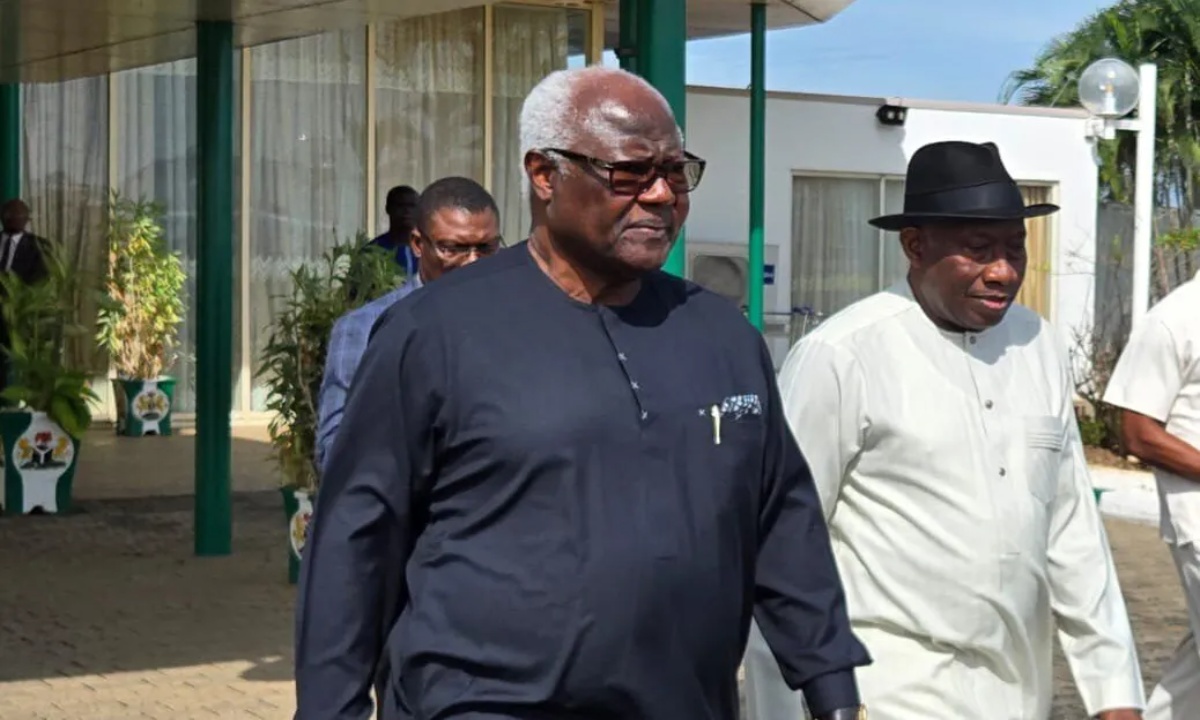
Former Sierra Leone President Ernest Bai Koroma has returned home after more than two years in Nigeria, bringing an important chapter in the country’s recent political crisis to an end and highlighting Nigeria’s continuing role in resolving political disputes in West Africa.
Koroma arrived in Freetown on Sunday, September 6, accompanied by Nigeria’s Foreign Affairs Minister Bianca Odumegwu-Ojukwu and former Nigerian President Olusegun Obasanjo. His return followed a diplomatic process involving Nigeria, the Economic Community of West African States and other stakeholders aimed at creating the conditions for his safe return.
A Return Shaped by Regional Diplomacy.
Koroma left Sierra Leone for Nigeria in January 2024 after being allowed to travel on medical grounds. His departure came after he was charged with treason and other offences in connection with an alleged attempted coup in November 2023.
The former president had denied involvement in the alleged coup attempt. The case became one of the most politically sensitive issues in Sierra Leone, coming months after President Julius Maada Bio was re-elected in June 2023 in an election whose results were disputed by Koroma’s All People’s Congress opposition party.
Nigeria subsequently became the location where Koroma remained for more than two years, with Abuja presenting his stay as part of efforts to reduce political tensions and encourage dialogue.
Treason Proceedings Cleared the Way Home.
Koroma’s return became possible after Sierra Leonean authorities withdrew the criminal proceedings against him. Reports published on September 7 said the treason case connected to the 2023 unrest had been discontinued, removing a major legal obstacle to his return.
His homecoming therefore represents more than the return of a former head of state. It also marks a significant development in Sierra Leone’s attempt to move beyond the political tensions that followed the 2023 election and the subsequent military uprising.
Koroma served as Sierra Leone’s president from 2007 to 2018. He was succeeded by Julius Maada Bio after the 2018 presidential election.
Nigeria’s Role Comes Into Focus.
The Nigerian government has presented the former president’s return as the conclusion of a regional diplomatic and confidence-building process.
Foreign Affairs Minister Bianca Odumegwu-Ojukwu said she accompanied Koroma to Sierra Leone on the instruction of President Bola Tinubu and described the development as the successful conclusion of sustained regional engagement.
Former Nigerian President Goodluck Jonathan also played a role in the process and was among those who saw Koroma off before his departure from Nigeria.
The development reinforces Nigeria’s traditional position as one of West Africa’s most influential diplomatic actors. Abuja has historically played a central role in regional conflict resolution, including through ECOWAS, and the Koroma case provides another example of Nigeria using diplomatic influence to help manage a politically sensitive dispute in the region.



