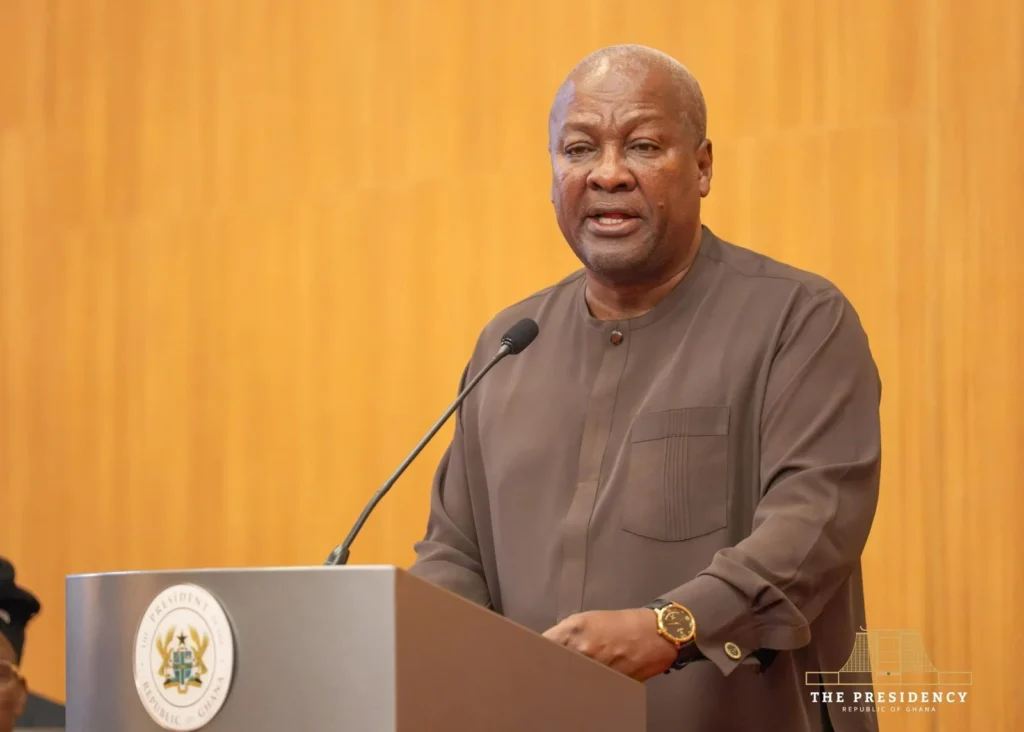
President John Dramani Mahama has dissolved the governing boards of nine major Ghanaian state institutions with immediate effect, opening a new phase in his administration’s efforts to reorganise leadership across strategic public enterprises and agencies. The decision, announced on September 2, affects institutions operating in petroleum, banking, mining, infrastructure, housing, postal services and sports, including the Ghana National Petroleum Corporation (GNPC), Bulk Oil Storage and Transportation Company Limited (BOST), Consolidated Bank Ghana Limited (CBG) and the National Sports Authority (NSA).
The Presidency did not provide a specific reason for dissolving the boards, but directed the relevant sector ministers to take all necessary steps, in accordance with the applicable laws and governing instruments, to implement the decision. It also confirmed that the affected boards would be reconstituted in due course, meaning the move is a restructuring of the governing bodies rather than a shutdown or dissolution of the institutions themselves.
Nine Strategic Institutions Are Affected.
The institutions whose boards have been dissolved are Prestea Sankofa Gold Limited, BOST, Volta Aluminium Company Limited (VALCO), CBG, Ghana Post Company Limited, the Road Maintenance Trust Fund, TDC Ghana Limited, GNPC and the National Sports Authority. Together, they cover some of the most economically and strategically important areas of Ghana’s public sector.
GNPC sits at the centre of Ghana’s petroleum industry, while BOST manages critical petroleum storage and transportation infrastructure. VALCO remains an important component of Ghana’s industrial and aluminium ambitions, and Prestea Sankofa Gold operates in the country’s mining sector. CBG, meanwhile, is a state-owned financial institution created during Ghana’s banking-sector restructuring and continues to play a role in the country’s financial system.
The other affected institutions also have important public responsibilities. TDC Ghana is involved in housing and urban development, the Road Maintenance Trust Fund supports road maintenance financing, Ghana Post manages the country’s postal network, while the National Sports Authority oversees sports development and related infrastructure. The breadth of the affected institutions suggests that the decision is part of a wider administrative intervention rather than a sector-specific restructuring.
Existing Management Teams Will Continue Operations.
The dissolution of the boards does not mean that the nine institutions will stop functioning. Their management teams will continue handling day-to-day operations while the government prepares to appoint new governing boards.
However, there are restrictions on what management can do during the transition. According to a letter from the Office of the President, management teams are not permitted to make major policy, financial or contractual decisions requiring board approval without prior authorisation from the appropriate authority.
That interim arrangement is designed to prevent major commitments from being made while the institutions operate without formally constituted boards. It also gives the government time to select and appoint new board members without creating a vacuum in the everyday administration of the affected organisations.
For institutions such as GNPC, BOST and CBG, the restriction could be particularly significant because their operations involve large financial commitments, contracts and strategic decisions. The quality and speed of the transition will therefore matter not only from a governance perspective but also for business continuity.
The Move Comes Amid Scrutiny of State-Owned Enterprises.
The board shake-up comes at a time when the performance of Ghana’s state-owned enterprises and agencies is receiving increased attention. Recent assessments of state-owned institutions have renewed discussion about financial performance, accountability, efficiency and the extent to which public enterprises contribute to national development.
The latest decision gives the Mahama administration an opportunity to place new leadership structures over institutions that have considerable influence on Ghana’s economy. However, dissolving boards by itself will not resolve the deeper problems facing state-owned enterprises. New boards will ultimately be judged by whether they can improve governance, financial discipline, operational performance and public accountability.
The challenge will be particularly pronounced in sectors where government institutions operate in commercially sensitive environments. Petroleum, banking, mining and industrial production require boards with technical expertise, financial independence and a clear understanding of both commercial and public-policy objectives.
National Sports Authority Board Also Dissolved.
The National Sports Authority is one of the most visible institutions affected by the decision. Its 15-member governing board, chaired by Dr Fred Awaah, has been dissolved along with the boards of the eight other institutions. The board had been sworn in in December 2025.
The change comes at an important period for Ghanaian sports, as the government continues to face pressure to improve sports infrastructure, administration and athlete development. The National Sports Authority plays a central role in managing sports facilities and coordinating aspects of national sports development, making the eventual composition of its replacement board particularly important.
For Ghana’s sports community, attention will now turn to whether the incoming board brings stronger representation from sporting federations, athletes, administrators and technical professionals. The government has not yet announced the names or composition of the replacement boards.
GNPC and BOST Carry Particularly High Economic Stakes.
Among the affected institutions, the changes at GNPC and BOST could attract the greatest economic attention. Ghana’s petroleum sector remains an important source of government revenue, foreign exchange and investment, while BOST plays a strategic role in the movement and storage of petroleum products.