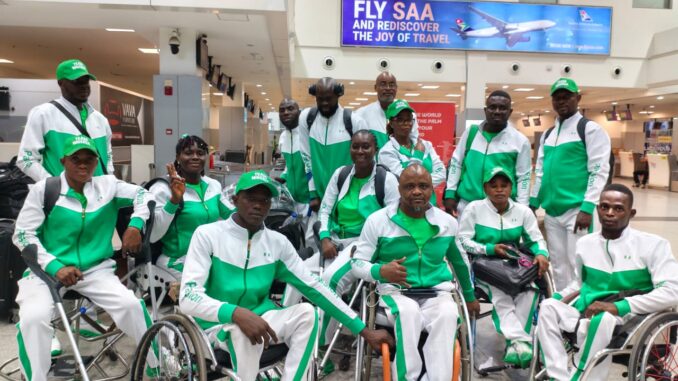
Nigeria’s women’s wheelchair basketball team has opened a new chapter in the country’s para-sport history, and captain Ijigbamigbe Gbemisola Olubisi is already looking beyond the achievement that put the team on the international stage. After helping Nigeria secure its first-ever place in wheelchair basketball at the Commonwealth Games, Ijigbamigbe says the next ambition is even bigger: taking the country to the Paralympic Games.
The breakthrough did not happen by accident. Nigeria defeated South Africa 8–3 in the final of the African qualifying tournament in Angola to secure its historic Commonwealth Games place. The result represented a major moment for a sport that has often struggled for funding, equipment, sponsorship and public attention in Nigeria.
For Ijigbamigbe, the achievement has therefore become about more than one tournament. It has demonstrated what Nigerian wheelchair basketball can accomplish when players are given the opportunity to compete, prepare and believe in themselves.
A Historic Commonwealth Breakthrough.
Nigeria’s qualification for the 2026 Commonwealth Games was the first time the country’s women’s wheelchair basketball team had secured a place in the competition. The victory over South Africa in Angola provided the decisive moment, but the significance extended far beyond the scoreline.
The team had to overcome the traditional difficulties facing many African para-sports programmes, including limited resources and inadequate access to specialised sporting equipment. Ijigbamigbe has said that confidence, teamwork and determination were crucial in helping the players overcome those obstacles.
The captain acknowledged that competing on such a stage initially came with fear and uncertainty. But as the tournament progressed, the team’s confidence grew, supported by the belief that they belonged among the best teams competing for qualification.
That psychological shift could prove just as important as the qualification itself.
Ijigbamigbe Wants More Than a Historic Appearance.
Rather than treating the Commonwealth breakthrough as the end of a journey, Ijigbamigbe sees it as the beginning of something much larger. Her ambition is now to help Nigeria qualify for the Paralympic Games, an objective that would take the country’s women’s wheelchair basketball programme into another level of international competition.
That goal will require sustained investment. Paralympic qualification is considerably more demanding than simply establishing a presence at one major multi-sport event, and Nigeria will need regular international competition, specialist coaching, appropriate facilities and modern sporting wheelchairs.
The team will also need a stronger domestic structure capable of identifying and developing players before they reach the national team.
For Ijigbamigbe, however, the recent breakthrough has provided evidence that the foundation exists.
Equipment Has Been One of the Biggest Challenges.
One of the most important issues raised by the Nigerian captain is the shortage of appropriate sporting wheelchairs. Unlike ordinary wheelchairs, equipment used in wheelchair basketball is specifically designed for speed, manoeuvrability, stability and physical contact during competition.
Ijigbamigbe recently praised the intervention of Bukola Olopade, Director-General of Nigeria’s National Sports Commission, after efforts were made to provide sporting wheelchairs for the team ahead of the Commonwealth Games. She described the development as an important improvement after years of equipment and funding difficulties.
That support could have a significant effect on performance. Athletes cannot be expected to compete consistently against international opposition when they lack equipment comparable to what their opponents use.
The challenge now is ensuring that support does not disappear after a major tournament.
From One Player’s Journey to a National Story.
Ijigbamigbe’s own sporting journey also reflects the wider potential of para-sport in Nigeria. She has explained that she was introduced to sport in 2018 almost casually, without initially imagining that the decision would eventually lead to an international career and the responsibility of captaining the national team.