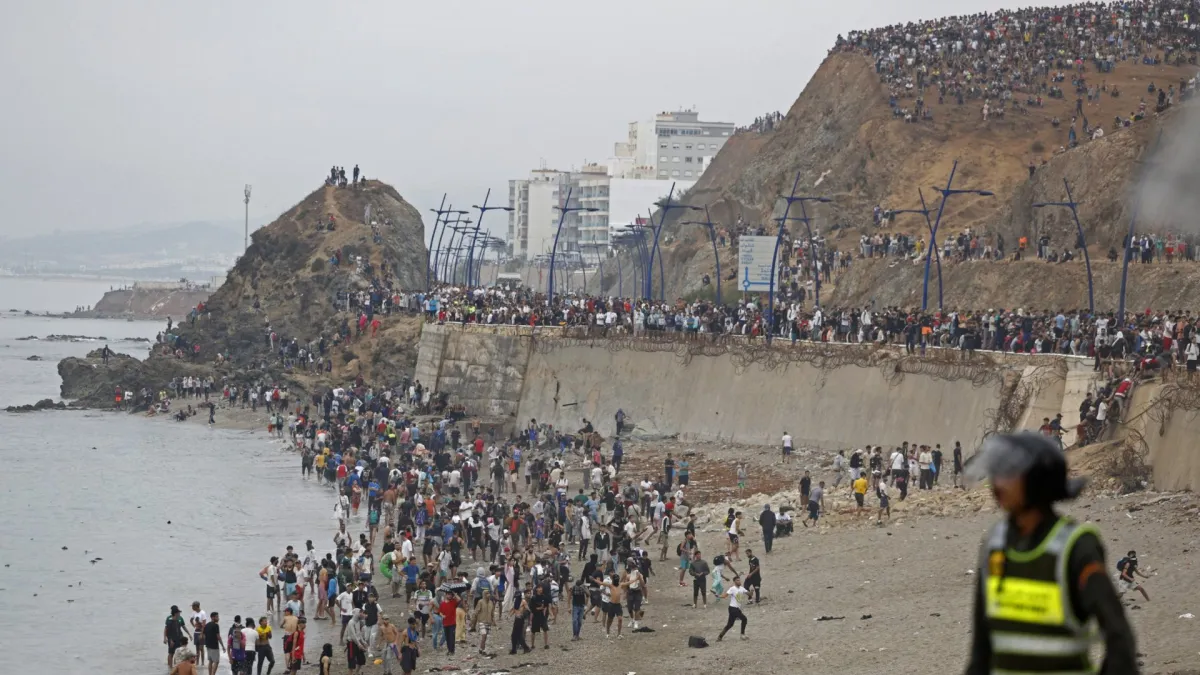
Ceuta is a small Spanish enclave on the North African coast, but its political and symbolic significance is far greater than its size. Situated on the African continent while forming part of Spain and, by extension, the European Union, Ceuta represents one of the most visible physical points where Africa and Europe meet — and where the enormous differences in opportunity, income, security and mobility between the two continents become impossible to ignore.
The latest tensions around the territory are therefore about much more than border security. Morocco has intensified security measures following renewed calls for attempted mass crossings, while Spain has reinforced its own border presence. Moroccan authorities have arrested hundreds of people in connection with attempts or plans to reach the enclave. The immediate response has once again been focused on preventing people from crossing, but the deeper question is what continues to push them towards the border in the first place.
A Border Bigger Than the Fence.
Ceuta is separated from Morocco by a heavily fortified border, but the physical barrier represents something much larger. It is one of the European Union’s few land borders on African soil, creating a geographical contradiction that has made the territory a powerful symbol of Europe’s relationship with its southern neighbour.
For someone standing on the Moroccan side of the border, Europe is not a distant destination thousands of kilometres away. It is physically visible and, in some places, only a short distance away. Yet the economic and political distance between the two sides remains enormous.
For migrants, that proximity can create a powerful sense of possibility. Reaching Ceuta can mean entering European territory and potentially accessing asylum procedures, employment opportunities, education and social services. For Spain and the wider European Union, however, uncontrolled crossings represent a complex combination of migration management, border security and political pressure.
That contradiction explains why Ceuta repeatedly becomes the centre of intense migration crises.
The Human Cost Is Easily Forgotten.
Behind the language of border security are people making decisions that often involve enormous personal risk.
Some migrants reaching the area have travelled through several countries before arriving in northern Morocco. Others are young people from Morocco itself who see Europe as offering opportunities that they believe are unavailable at home. Their backgrounds differ, but the motivation is often connected to the same fundamental questions: employment, income, security and the possibility of a better future.
The physical journey can be dangerous. People attempting to cross maritime routes or heavily secured borders risk injury, detention and, in some cases, death.
Yet the desperation behind these journeys does not disappear when a border is reinforced.
This is perhaps the most uncomfortable aspect of the Ceuta debate. European governments can increase surveillance, Morocco can deploy additional security forces and physical barriers can become more sophisticated, but none of these measures directly addresses the economic and social pressures that make migration attractive in the first place.
Morocco Is Caught in the Middle.
Morocco occupies an increasingly complicated position in this relationship.
Geographically, it is the immediate gateway between large parts of Africa and Spain. Politically, it has become an important partner for Spain and the European Union in efforts to control irregular migration.
That cooperation has strategic and economic benefits for Morocco, but it also places the country under considerable pressure.
Moroccan security forces are expected to prevent migrants from reaching Spanish territory, even when those migrants include Moroccan citizens. At the same time, Morocco itself faces many of the economic pressures that drive migration elsewhere in Africa.
This creates a difficult question: to what extent is Morocco being transformed into Europe’s first line of defence against African migration?
It is a question that deserves serious discussion because migration cooperation cannot be viewed solely through the lens of European security. It also has consequences for African countries and African citizens.
Europe’s Border Strategy Has Limits.
Europe has invested heavily in controlling migration routes across the Mediterranean and strengthening cooperation with countries such as Morocco.
There is a legitimate argument for secure borders and orderly migration systems. Governments have a responsibility to manage who enters their territory, while asylum procedures need to be organised in a way that protects both migrants and host communities.
But border enforcement has a limit.
It can change the route people take. It can make journeys more dangerous. It can discourage some people from attempting the journey. What it cannot easily do is eliminate the economic inequality that makes migration attractive.
If a young person sees limited employment opportunities at home while believing that Europe offers significantly higher wages and greater economic security, the existence of a fence may not be enough to change that calculation.
The route may simply become more dangerous.