Cameroon’s Historic WAFCON Triumph Has Sparked a Debate Over Who Really Built the Champions.
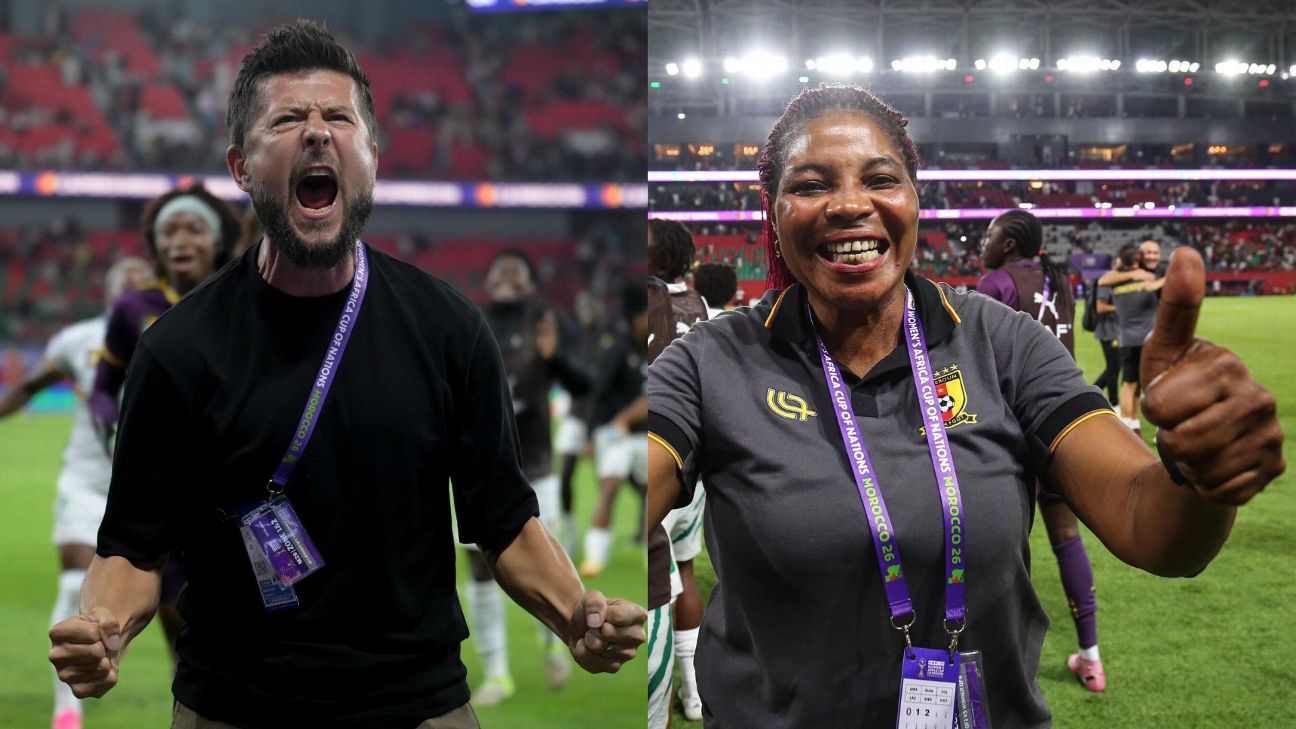
Cameroon’s maiden Women’s Africa Cup of Nations title should have been a straightforward celebration of a historic achievement. Instead, the triumph has opened a more complicated conversation about leadership, expertise and recognition within African football. On 16 August 2026, the Indomitable Lionesses defeated Malawi 3–0 in Rabat to win the WAFCON for the first time in the country’s history. At the centre of the achievement was Valentine Nguele, who became the first woman to lead Cameroon’s senior women’s national team to continental glory. Yet as the celebrations continued, attention also turned to Dimitri Lipoff, the French technical coordinator whose contribution to the rapid construction of the championship-winning team has generated considerable discussion.
The temptation is to turn the story into a competition between the two: Nguele as the local coach who stood on the touchline and Lipoff as the international expert who supposedly built the team from behind the scenes. But that interpretation risks oversimplifying one of the most remarkable coaching projects in recent Cameroonian football. The more uncomfortable and interesting question is not whether one replaced the other, but whether the public narrative is already beginning to give greater weight to foreign technical expertise while overlooking the achievement of the Cameroonian woman who officially led the team to its first continental title.
A Team Built in a Matter of Weeks.
The circumstances surrounding Cameroon’s campaign make the achievement even more extraordinary. The country entered the expanded 2026 WAFCON as a late replacement after failing to qualify through the conventional route, meaning the new technical team had to build a competitive squad against the clock. There was no luxury of a long preparation cycle, no extended sequence of competitive matches and little room for experimentation.
FECAFOOT president Samuel Eto’o appointed Valentine Nguele as head coach and selector in June, while Dimitri Lipoff was brought into the structure as technical coordinator. The timing left the staff with roughly six weeks to identify players, assess domestic and diaspora talent, establish a tactical framework and develop the kind of collective mentality required to compete against teams that had spent considerably longer preparing for the tournament.
That context is essential when assessing Lipoff’s contribution. His international experience and background in women’s football gave the project an important technical dimension at a moment when Cameroon needed to move quickly. His experience with clubs and teams including Paris Saint-Germain, Olympique Lyonnais, Wuhan Jianghan, Napoli Femminile and Al Ahly Women gave him knowledge of different football environments and player-development systems. The speed with which Cameroon assembled a competitive squad suggests that his role was far from ceremonial.
But recognising that contribution does not automatically make Nguele a figurehead.
Valentine Nguele Was Entrusted With the Team.
Nguele’s appointment carried both sporting and historical significance. She was not brought into the technical staff as a symbolic presence after the important decisions had already been made. She was appointed head coach and selector, giving her formal responsibility for the team’s sporting direction.
More importantly, she brought something that no foreign résumé could replicate: an understanding of Cameroonian football and the players themselves. As a former Indomitable Lioness and a coach who had worked within the domestic women’s game, Nguele understood the environment in which the team had been assembled. She knew the realities facing local players, the expectations surrounding the national team and the cultural dynamics that can influence an international dressing room.
She also introduced what she described as a “Warrior Mindset”, placing emphasis on discipline, unity and mental strength. Those ideas became particularly important as Cameroon progressed through the knockout stages, where the margin between success and failure became increasingly narrow.
Lipoff’s Contribution Cannot Be Dismissed Either.
At the same time, it would be unfair to minimise what Lipoff brought to the project simply because Nguele was the official head coach.
The Frenchman arrived with a background that exposed him to several of the world’s more developed women’s football structures. That experience was particularly valuable for a Cameroon side being assembled under extraordinary time pressure. Recruitment, player assessment, tactical organisation and preparation all had to happen quickly.
The task was not simply to select the best available players. The technical team had to determine which players could function together, identify the strengths of the diaspora contingent, integrate domestic talent and create a system capable of competing immediately.
Lipoff’s experience could therefore have made a significant difference. The public record and statements from the coaching staff suggest that he was an important part of that process.
The mistake would be to confuse importance with ultimate authority.
The Tournament Offered a Test of Nguele’s Leadership.
Whatever happened during preparation, Cameroon’s campaign was ultimately decided in the knockout stages.
The Lionesses eliminated Nigeria in the quarter-finals, overcame Morocco in a dramatic semi-final penalty shootout and then defeated Malawi 3–0 in the final. Those were three very different challenges, requiring the team to demonstrate tactical discipline, resilience and emotional control.
The victory over Nigeria was particularly significant because the Super Falcons entered the tournament with a long history of dominance in African women’s football. Eliminating them required Cameroon to execute under immense pressure. Against Morocco, the challenge was even more complicated because Cameroon had to withstand the emotional intensity of facing the host nation before eventually prevailing on penalties.
Then came the final, where Cameroon produced its most complete performance of the tournament.
These moments matter when assessing Nguele’s role. A head coach’s responsibility does not end with recruitment or training-ground preparation. Managing players, making decisions during matches, maintaining confidence and responding to the psychological demands of knockout football are central parts of the job.
Nguele Herself Has Refused to Turn the Success Into a Personal Victory.
One of the most revealing aspects of the debate is Nguele’s own attitude towards Lipoff.
Following Cameroon’s victories in the knockout stages, she publicly acknowledged the French coach’s international experience and spoke about the complementary nature of the technical staff. Rather than presenting herself as the sole architect, she recognised that different members of the team brought different forms of expertise.
That approach is important because it offers a more credible explanation of Cameroon’s success.
A head coach does not have to be the most experienced person in every area. In fact, good leadership often means recognising where others possess greater expertise and allowing them to contribute. Nguele’s willingness to acknowledge Lipoff does not diminish her authority. It could instead demonstrate confidence in her own position.
The problem arises only when that acknowledgment is interpreted as evidence that she was not really in charge.
Where the “Front” Narrative Becomes Problematic.
There is a legitimate question about the visibility of Lipoff during the tournament. His international experience made him an obvious figure for media attention, and his role in the team’s rapid preparation naturally attracted interest.
That visibility, however, should not automatically be converted into a claim that he was secretly running the team.
There is currently no credible evidence establishing that Nguele was merely a front for Lipoff. The official structure identified her as head coach and selector and him as technical coordinator. Neither has publicly claimed the other’s role.